Gradeon
An AI pre-grader for trading cards, from two phone photos to a grade.
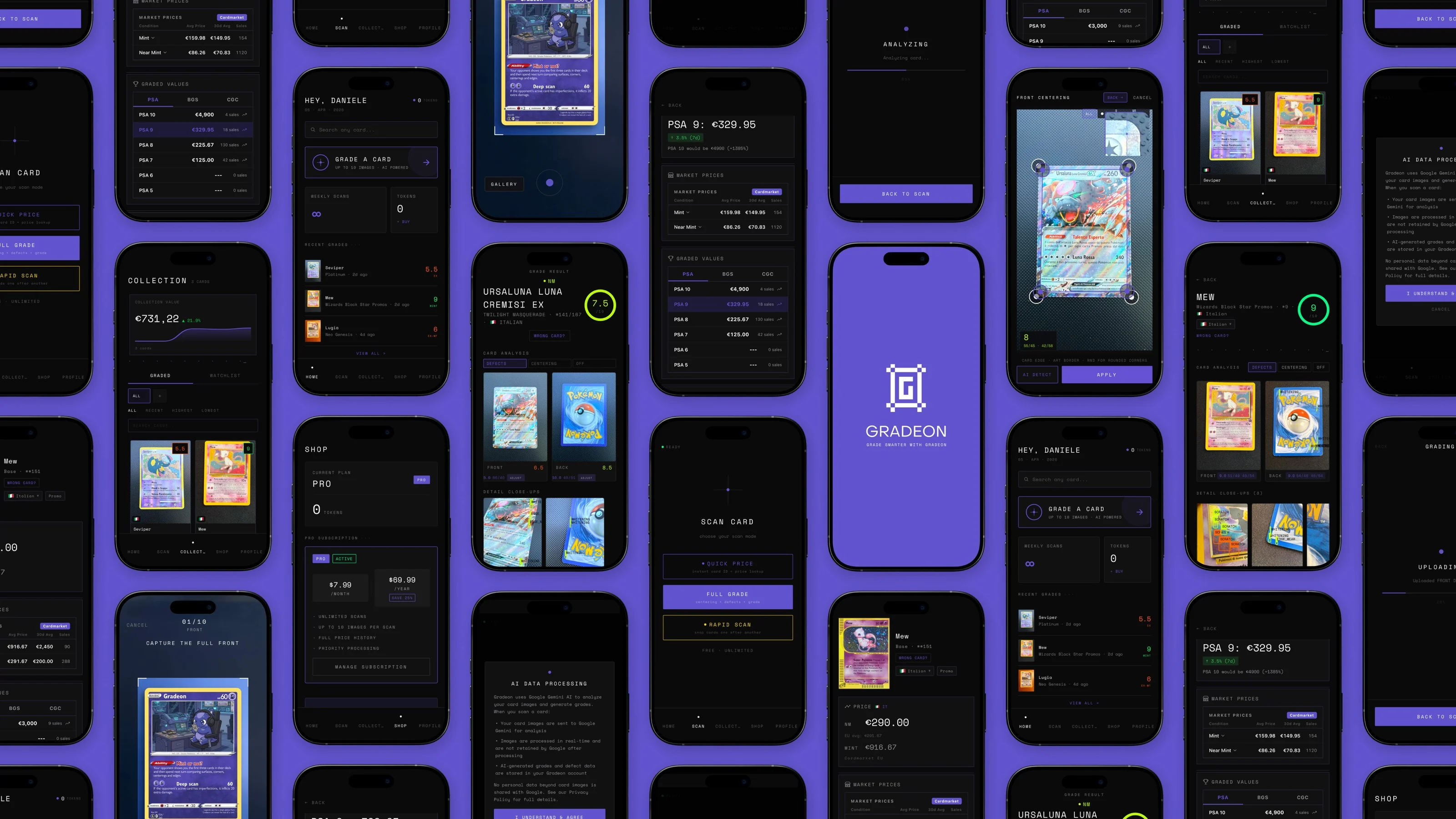
Know the grade before you pay to submit.
Collectors pay PSA, BGS or CGC to grade their cards without knowing what grade will come back. Gradeon answers that question first: from two phone photos it estimates the grade a professional would most likely give, shows every defect it found, and keeps track of what the collection is worth.
I co-founded Gradeon with Federico Vietti in October 2024. The two of us designed and built everything: the product, the app on iOS and Android, the brand and the website, with heavy use of AI along the way, Claude and Gemini; Gemini also runs the card analysis inside the app. It supports Pokémon, One Piece and Riftbound cards, in five languages.
How a pre-grade is built
Every step is on screen in the app. Scroll, and one card is pre-graded: the same story runs on gradeon.ai, built as a scroll-driven section.
One card, five steps
- 01 · Capture
Photograph the front and the back
Two phone photos are enough. Add close-ups of a corner or an edge and Gradeon inspects those too.
- 02 · Centring
Measure the borders
Gradeon finds the card edge and the printed border on every side, then you confirm the eight pins with one tap.
- 03 · Defects
Draw every defect on the photo
Eleven defect types, each with a severity from 1 to 5. Glare, holo patterns and factory cuts are not defects.
- 04 · Sub-grades
Score four areas, front and back
Surface counts 35%, corners and edges 25% each, centring 15%. No side sits more than one point above its weakest area.
- 05 · Pre-grade
One grade on the scale you know
A PSA-comparable pre-grade from 1 to 10 in half steps: the grade a professional would most likely give, before you pay to submit.
Pre-grades are AI estimates, not official PSA, BGS or CGC grades. Illustrated card; numbers from a worked example.
- 01
Show what the AI sees
Every defect is drawn on the photo: eleven defect types, each with a severity from 1 to 5. Glare, holo patterns and factory cuts are not counted as defects. Collectors trust a grade they can check. - 02
Keep a human where the AI is weakest
Gradeon finds the card edge and the printed border on every side, then the collector confirms the eight centring pins with one tap. - 03
Grade the way graders do
Four sub-grades, front and back, weighted like a professional would weigh them: surface 35%, corners 25%, edges 25%, centring 15%. No side scores more than one point above its weakest area, and the final grade runs from 1 to 10 in half steps. - 04
From a grade to a decision
The collection sits next to Cardmarket and TCGplayer prices and graded values, so the question becomes practical: submit, sell or hold.
In the app
The real thing, recorded in the app: a card’s defects marked on the photo, the four sub-grades and the final pre-grade.
The brand
We built the brand with the product: a pixel G and the line “Grade smarter. Collect better.”, over the cards it grades.
Wardeye
Our second product reads Riftbound live streams while players play and names the cards on the table. Point at a card and Wardeye shows its image and name.
Where it stands
Gradeon is live on the App Store and Google Play, in five languages. Every collector gets three free full grades a week. Pre-grades are AI estimates, not official PSA, BGS or CGC grades, and the app says so.